Monday, October 20, 2014

Anja and Andringita: Ring-Tailed Lemurs and Chameleons

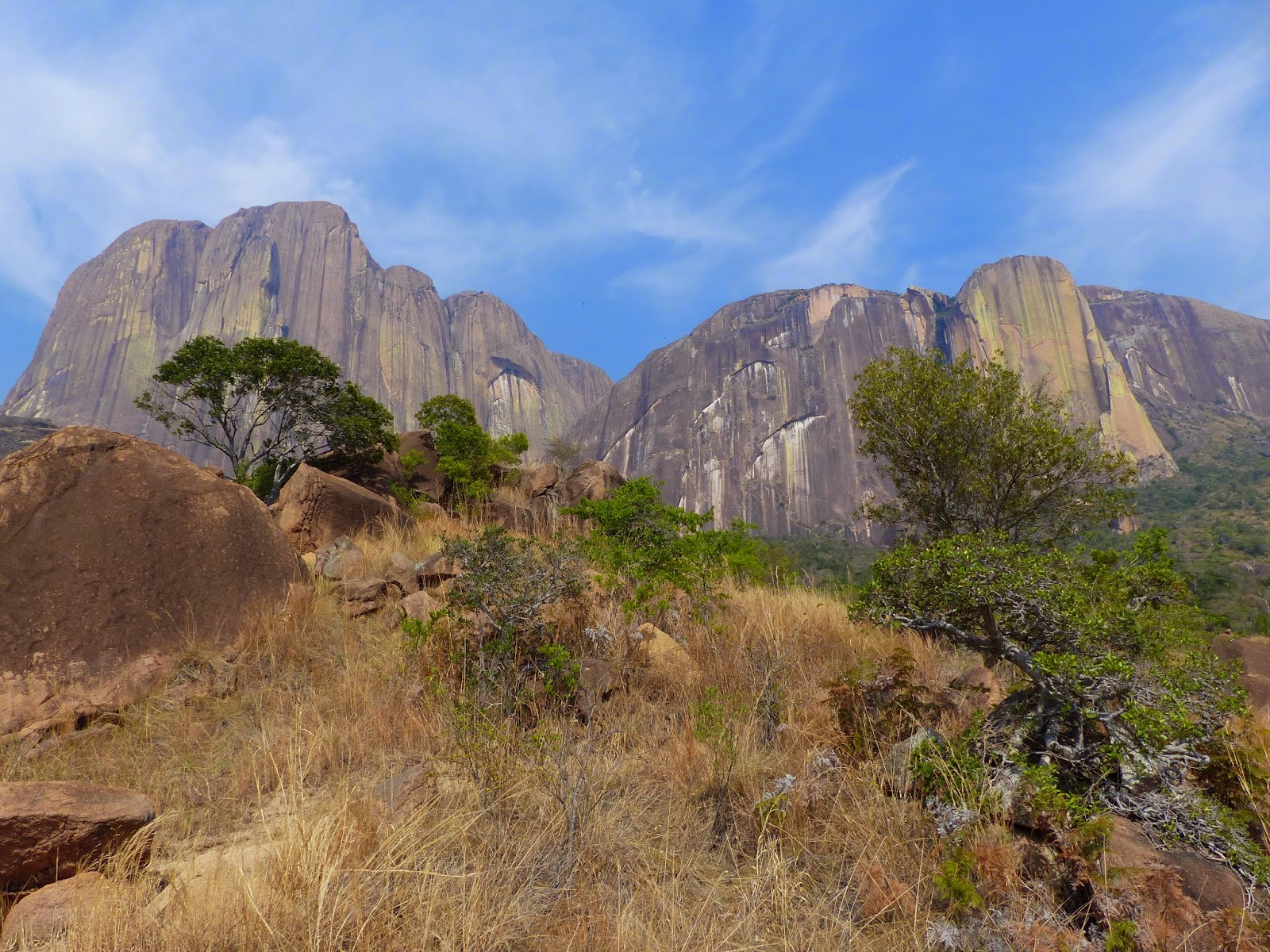
Earlier this week, we resumed our tour of Madagascar’s reserves and national parks.  Heading south from Ambalavao, the community-run Anja Reserve was our first destination.  Relative to many of the sprawling national parks, the reserve was diminutive, with only 37 hectares of mountain and forest to explore.  The small area, bounded by three distinctive peaks, is home to hundreds of ring-tailed lemurs, various types of chameleons, and many weird-looking insects.


Hiking into the reserve, we were lazily greeted by the first of many troops of ring-tailed lemurs.  With their distinctive tails, these unique animals could briefly be confused with a raccoon, at least until they emit one of their cat-like calls or effortlessly jump to the next tree.  Although we arrived at the reserve just in time for the lemurs’ midday treetop nap, there was still plenty of activity.  A few were prowling along the rocks or descending to the river for a drink of water.


Following our local guide through the forest, we scrambled through the reserve’s shady caves where the lemurs sleep at night and clambered to the top of some of the largest boulders for the best views of the landscape.  Several Betsileo tombs sunk into the rocks were also scattered through the forest.

Although it was certainly exciting to meet so many ring-tailed lemurs, we were equally intrigued by the philosophy behind the community-run initiative.  Much like the impressive conservancy we encountered in Namibia, the local villages have created the Anja Reserve and are in charge of its operations.  Besides the obvious benefits to conservation in a region where much of the forest has been replaced with agriculture, the revenues from the reserve are directly invested into the community.


After our visit with the lemurs, we continued our southbound journey on the N7.  As a series of sharp peaks interrupted the landscape of the hauts plateaux, we exited the tarred highway to travel southeast along a bumpy dirt track.  We were headed to Tsara Camp in the Tsaranoro Valley, alongside Andringita National Park.  Several mountains, including some of Madagascar’s highest peaks, formed a scenic backdrop to the secluded tented camp.  This region of the country is known for its trekking and mountain climbing, and we had just one full day to explore.


To the west, the steep face of the Tsaranoro Massif loomed above the valley, with the aptly named Mt. Chameleon immediately adjacent.  Without the two full days required to summit Mt. Boby, Madagascar’s second highest peak, and without the free climbing skills to complete the ascent of the neighboring Tsaranoro Massif, we settled on climbing Mt. Chameleon.


On Friday morning, we set off in the heat from Tsara Camp, accompanied by our guides as well as a friendly British couple.  The neighboring villages and rice paddies gradually gave way to an allegedly lemur-filled sacred forest in the foothills.  Although we did not meet any new lemurs, we did come across a lovely natural swimming pool, several tombs of the Bara tribe, and various unique rock formations.  Climbing out of the forest, the blazing heat returned in full force.  Although we did not view this as an impediment to our progress, our guide Cedric disagreed, calling for the first of many breaks along the trail.  This turn of events came as no surprise given Cedric’s affinity for red, yellow, and green clothing, as well as for Malagasy reggae music.  If these clues were not enough of an explanation for our many rest stops/smoking breaks, Lala had also politely informed us that Cedric’s quirky and absent-minded demeanor was “because of the cannabis.”  Needless to say, our progress was slow, particularly with additional breaks for snacks and sightings of weird bugs. 

As we neared the peak, which looks more like a real chameleon the closer you get, we decided to finish the ascent ahead of the rest of the group and lackadaisical guide.  We raced up the final steep slope and took in the precipitous view over the edge, which our guidebook had warned would be vertigo-inducing.  We certainly weren’t disappointed by either the steep drop or the epic views of the surrounding chain of mountains. 


The trek down the other side of Mt. Chameleon offered similar awesome vistas, as well as a short section of path between two valleys reminiscent of the Lord of the Rings.  It seemed like the perfect location for the picnic we knew one of the guides was carrying, but instead of stopping to enjoy the view, we continued to trudge down the steep trail.  Just as Stephanie decided she couldn’t go a moment longer without a bite to eat, we arrived at a small hotel on the outskirts of a village.  It turned out that our picnic was much fancier than anticipated!  The guides had brought real plates for the pasta salad and we could buy a beer to accompany the meal.  It was well worth the wait.


Back at camp, we enjoyed the beautifully isolated surroundings complemented by three-course dinners.  We have been continually impressed with the food here in Madagascar, even in the most remote locations.  One evening, a friendly hedgehog even visited us at mealtime, perhaps also intrigued by the gourmet cuisine.  Of course, it’s not all cute hedgehogs and lemurs – we also encountered what we have determined to be a monstrous “cockahopper” in our tent, which once again put Giorgio’s manliness to the test.  (Stephanie, as usual, outsources all killing of bugs, spiders, and scorpions to Giorgio.)

On Saturday, we left the mountain-ringed Tsaranoro Valley behind and merged back onto the southbound N7 en route to Madagascar’s vast plains and Isalo National Park.

#stephandgio

Sunday, October 19, 2014

Madagascar’s Hauts Plateaux: South on Foot

After stumbling into our hotel (thankfully located quite close to the train station) at 5 am, we collapsed into bed.  We were scheduled to spend the next three days camping and trekking south from Fianarantsoa toward the next town, Ambalavao.  However, we weren’t eager to trade the hard-won comfortable bed, easily accessible (real) toilet, and hot shower, for the cold hard ground after just two hours of sleep on the FCE.  The prospect of hiking up a mountain for six to seven hours was equally unappealing.  Rubbing sleep from our eyes, we briefly explained this to our local guide, who was happy to revise our hiking route and pick us up the following morning instead.

Tuesday morning, we set off from our hotel in a much-improved state of mind -- more than ready to trek through the hauts plateaux.  Lala deposited us at a brick church alongside the N7 with our guide, Mamy, and the three of us set off south down a path through the red fields and green rice paddies.   Although very few trees could be found dotting the rolling hills (most are victims to slash and burn farming or demand for firewood), our hike passed through a series of incredible vistas as we crossed through Betsileo villages and climbed the hills and boulders.  Mamy explained that our trek would first take us over a large hill, followed by a brief stop in the village below and a more serious climb up and over Somaina Mountain. 

In the village, Mamy paused for a detailed explanation of the mechanics of rice cultivation in the region (much more interesting and complicated than it sounds).  Several men were also busy fashioning red bricks out of a mixture of mud and zebu dung, starting the process of building a new house.  In addition to the standard zebu grazing in the fields, several gobbling turkeys were busy roaming through the village.

Throughout the entire stop, we were trailed by a troupe of wide-eyed children.  Beginning our climb up Somaina Mountain, we were joined by two local “guides” from the village.  At first we weren’t quite sure why we needed another guide, but then our clear path abruptly ended and the rest of the ascent crisscrossed boulder fields and actual fields.  We never would have found the way on our own, even with Mamy.          


At the top, we were rewarded with views of the valleys and villages spread out below.  The guides also showed us some of the local tombs, which were created out of caves or dug into the hillside.  After saying farewell to our local guides, we wound our way down the southern face of the mountain, stopping for a relaxing lunch en route.  After an easy descent of the mountain and traverse of several more rice paddies, we arrived at an incredibly organized campsite.  Camp Oliha should take note!


We settled in alongside the village rice paddies to enjoy the view and read for a while on our iPads before the sun set (even Giorgio has replaced watching TV with reading).  Out of the blue, we were mobbed by a group of girls eager to turn the pages of Giorgio’s book.  After flipping through a few pages, they ran off laughing, only to return with the rest of the village children 30 minutes later.  Everyone crowded around Giorgio to turn the pages of his book, which was entertaining, but not as entertaining as looking at the photos of Madagascar in the guidebook on Stephanie’s iPad or having their photos taken repeatedly.  Unlike the children trailing after us in Lesotho, our new band of followers wasn’t asking for money or candy, they were simply curious about the vazaha and their strange electronics.


We were not treated to a freshly slaughtered chicken for dinner, but instead got to sample a local rum punch (after pouring some out in honor of our ancestors) accompanied by a three-course dinner ending with pineapple flambé.  This was clearly a classy camping trip.  Even better, we got to spend hours chatting with Mamy and learning all sorts of things about Madagascar.  Since Giorgio is continuing his quest to become a fluent Malagasy speaker, Mamy helped him add new slang to his vocabulary.  More importantly, the chance to speak with someone around our own age about everything from politics, to music, to local traditions was incredibly refreshing.

In the morning, we awoke to the sound of the villagers making their way to the adjacent rice paddies.  We were clearly lazy sleeping in past 6:30 am.  Mamy lead us through a new series of villages on our way southeast back to the N7, where we would rejoin Lala.  It was a busy morning since it was market day in Ambalavao, our destination.  Carrying bags of rice and other goods to sell, everyone was making their way to the main road.  Most importantly, Wednesday was the day for the weekly zebu market, and men were either herding the animals to Ambalavao for sale or en route to town to buy a new zebu. 

After our hike, Mamy had promised that we would make a stop at one of the vineyards in the area.  We have been skeptical about Malagasy wine, but figured we should at least give it a try, particularly since it isn’t typically exported.  How bad could it be?  It turns out that Malagasy wine is limited to local consumption for a reason.  We aren’t quite sure what grapes are being grown, just that they are cultivated from a hybrid of French and local vines.  Since we are clearly wine-making experts, we have determined that the issue with Malagasy wine is the lack of oak barrels.  Oak barrels are either unavailable, too expensive, or both.  What’s the next best option?  Plastic barrels.  We’ll leave you to imagine what the wines taste like, accompanied by hints of plastic.  Fortified wines and aperitifs, as well as Malagasy grappa, are a lot more forgiving.

Buoyed by the local spirits, we made our way onward to the Ambalavao zebu market, the largest in the country.  Stephanie had imagined that a zebu market might be a bit like the state fair or a rodeo, but that’s not quite it.  Groups of zebu were milling around the dusty open-air market, surrounded by their herders, each of whom carried the perfect stick to keep the animals in line.  The zebu were oddly subdued, although occasionally one would let out a frustrated "moo" or escape from a herder to dash across the market.  With a zebu on a run, the scene briefly transformed into Pamplona, as people made sure to avoid the temporarily stampeding cattle.  Mamy told us that amidst this seeming chaos there was an underlying order, as the herders negotiated for the best prices and verified the paperwork for prospective purchases.  Zebus also have yellow tags, or passports, on their ears, indicating that they can be transported throughout the country.  The cattle are incredibly important for the local economy, particularly since many families measure wealth in zebu – Giorgio has determined that the zebu market is Madagascar’s nascent financial market, with vast amounts of cash changing hands every market day and zebu brokers and traders making a living this way.

Next, Mamy guided us through the non-zebu market, another scene of organized chaos.  Although vendors were selling anything and everything, they did so in a specific order.  First we encountered electronics, then clothes, then fruit, then vegetables, and so on.  On our own, we would have become hopelessly turned around as we made our way down the crowded aisles, but Mamy easily directed us past the diverse vendors.  As we exited the market, he spotted several pousse pousse idling nearby.  Had we been in one of these Malagasy rickshaws elsewhere?  When we told him we had missed out on this experience, he quickly negotiated with the drivers and off we went.  Mamy was even lucky enough to pick up a pretty pousse pousse hitchhiker for the second half of his trip.  It is a bit disconcerting to be pulled through the city streets and even along the national highway by a barefoot “driver.”  At least it isn’t an activity just for vazaha, though, as we have seen the locals transported in the same fashion in several towns. 

We are now back on the highway driving south -- stay tuned for more updates from the mountain ranges and forests of Madagascar's national parks! 


#stephandgio

Saturday, October 18, 2014

The FCE: We Recommend the First Seven Hours, Not the Next 13+

At 7 am Sunday morning, we were ready to board the Fianarantsoa-Côte Est train (more commonly known as the FCE) from Manakara to Fianarantsoa.  As expected, the train was not ready to depart at 7 am as scheduled.  We milled about in front of the crumbling depot amidst Malagasies queuing for tickets, vendors selling pineapples and bananas, and various vazaha (foreigners) looking out of place like us. 

We were scheduled to take the FCE the full length of its tracks, a trip described in glowing terms by every book and article we had read about Madagascar.  The train travels eastbound on Tuesdays, Thursdays, and Saturdays, and returns west on Wednesdays, Fridays, and Sundays.  Along the way, it navigates through a series of remote hamlets, providing the only means of transport for the villagers and their crops since roads don’t reach these locations deep in the jungle.  All of the towns along the route depend on the FCE for their livelihood, as it transports their crops for sale in larger cities.  Without the train, the villagers would be reduced to subsistence farming, which would in turn destroy the lush forest surrounding the towns.  When cyclones caused landslides to cover the tracks in 2000, several NGOs as well as USAID stepped in to make sure the train could resume its daily trips, thereby ensuring the livelihood of the townspeople and the biodiversity of the surrounding jungle.

Even without Lala’s repeated warnings that the FCE could not compare to a European train, we were well aware that our journey was unlikely to be as comfortable as an Acela trip from NYC to Boston.  He repeatedly warned us that “first class” only meant “better class."  One of our guidebooks indicated that the trip could take anywhere from seven to 12 hours, so we settled in for the long haul, bringing a picnic lunch, snacks, playing cards, and books.

Around 7:30 am, whatever had caused the train’s delay was resolved and we crowded into the depot with the rest of the passengers to show our tickets prior to boarding.  Lala shepherded us through the crush of people and, after providing a small bribe to the ticket taker, temporarily boarded the train with us to make sure we were all set with our seats.  He had arranged for us to sit on the northern side of the car, which boasted the best views along the way.  We quickly settled in to our window seats, the only passengers in the first class section of the car other than a German couple.  Seats and standing room for second class were located directly inside the train doors, with a prime location next to the bathroom, while first class was set apart at either end of the car with a sign marked reservée.

With the sound of the train’s horn and accompanying conductor’s whistle, the locomotive slowly clattered out of Manakara at 7:45.  As the train pulled away from the station, we took bets on our arrival time in Fianarantsoa, with Stephanie estimating 8:30 pm (12 hours, 45 minutes) and Giorgio optimistically guessing 6:30 pm (10 hours, 45 minutes).  Although the tracks briefly paralleled the local road, soon enough we were chugging past verdant green rice paddies, banana trees laden with fruit, and hump-backed zebus grazing.  Often, we would simply listen to the train’s wheels loudly clank against the uneven tracks as branches from the surrounding lush forest scraped against the sides of the train and crashed through the large open windows.  Just as we began to think the train was traveling through a deserted jungle, we would hear the shouts of small children as they jumped out of the surrounding grasses to wave enthusiastically at the passing train.  We aren’t sure if their enthusiasm was due to the sight of so many vazaha, simple excitement seeing the train, or both.


Of course, the purpose of the FCE is not to provide tourists with a scenic journey through remote parts of Madagascar, but to load and unload cargo on its east and westbound trips.

There are 18 stops along the route, where the train idles for anywhere from 10 minutes to over an hour, loading baskets of bananas, bundles of firewood, and other goods.  At the first few stops, vendors (mostly children) ran up to the train offering bananas and other fruits for sale.  As our journey progressed, the offerings became more varied.


Did we want local peppercorns in any of five different colors?  Crayfish?  Meatballs?  Ginger?  Sausages?  Un poulet (alive, of course)?  Lala had sternly warned us to only buy fruit from the multitude of vendors – the other food would make us sick.  So we ignored the offers of live chickens and delicious-looking fried goods and settled on buying a large bunch of bananas for 1,000 ariary (slightly less than 40 cents).  We were also proud of negotiating the price of two battered cans of beer down from 6,000 to 5,0000 ariary in our broken French.


We slowly made our way east, marveling at the scenery as well as the feat of constructing the train tracks in such a remote location.  48 tunnels and 67 bridges aid the FCE’s eastward trajectory.  The train trundled over muddy rivers and through narrow tunnels where you could reach out and touch the stone walls in the pitch dark if you so desired.  A few of the second class passengers gradually joined us in first class and at many of the stops, their friends would hop on the train to chat before the departure whistle blew.


We were never quite sure how long the train would stay at any given station and were worried about being left behind if we strayed too far, so we generally watched the organized chaos from the windows of the train.  We didn’t want to end up sprinting after the train to leap through the doors like many of the local children.  We stayed at one stop in the middle of a field for so long that we even began a lengthy game of Uno, which several of the men on the train watched intently, attempting to ascertain the rules.

We thoroughly enjoyed the first seven hours of our journey, with a constantly changing backdrop of sights and the accompaniment of the rhythmic rattling of the train wheels. However, at 3 pm, our scenic journey came to an abrupt end nowhere near our final destination.  The train screeched to a halt in a larger town, which even boasted a school and a Catholic church.  Chaos ensued.  Before anyone could get off the train, seemingly the entire populace of the town began to push its way onboard.  Kids, grandparents, and even a nun crowded into the car.  Babies were passed through the windows.  Obviously, the new passengers were not alone, and boarded with boxes of squawking chickens, several giant baskets of bananas, and numerous other mysterious bundles.  We tried to guard our seats from the invading hordes, but to no avail.  Apparently, it no longer mattered whether you had a first or second-class ticket – whoever pushed the hardest claimed a seat.  Our new seatmates were a young couple and their baby – both parents, at most 18, were already busy changing diapers and breastfeeding in the cramped quarters, providing us with our very own Malagasy advertisement for birth control.  Another man was quite convinced that he was going to either sit next to Giorgio or stand right where his knees were, but Giorgio wasn’t having any of it.  This particular battle would only intensify throughout the next thirteen hours of our trip.  

All of the new arrivals seemed to know one another, exchanging gossip, letting their children play together in the aisle, and buying dinner from the vendors alongside the train.  The baby seated across from us kept busy trying to steal the rest of our bananas.  Giorgio offered him one, but it turned out the youngster really just wanted to throw the fruit on the floor so that was the end of sharing.  We also desperately wanted to put some Neosporin on a large oozing cut on the child’s forehead, but didn’t think we could do so politely.  It turned out that there was no need for our Western medicine because at one point, a passenger yanked some leaves off a passing tree and handed them to the child’s mother, who mashed them up and rubbed them into the cut.

Even in the crowded car, the rest of the trip, which should have been coming to a close, would have been bearable.  But then we pulled into a station at sunset and didn’t pull back out after the usual 30 minutes.  After an hour sitting in the dark, we began to wonder what was happening.  (If you thought this train would be equipped with lights, you would be wrong.)  We would have remained in the dark, both literally and figuratively, had it not been for a friendly French tourist who stopped by to explain that the engine was broken and they were sending oil to fix it all the way from Fianarantsoa, about three hours away.  How do you fix an engine with oil?  Why don’t they carry spare magical oil if this is a common problem?  As usual in Madagascar, we weren't quite sure, so we settled in to wait in the dark for the repair train, wishing we hadn’t already eaten the entirety of our picnic lunch and snacks.  As we were beginning to give up hope, the sound of a motor pierced the silence.  Of course, our ancient train was not easily repaired, so someone decided the best course of action would be to tow the train the rest of the way to Fianarantsoa.


Off we chugged into the darkness, even more slowly than before.  There is a significant gain in altitude between Manakara and Fianarantsoa, making it more difficult to tow the train full of passengers and cargo.  The train is so important to the towns along its route that even when it is incredibly late, it still stops at each and every station or banana field.  All requisite tasks are performed in the dark, with a few flashlights for illumination.  Essentially trapped in our seats by the hordes of passengers camped out in the aisles, we dozed fitfully as the train continued.  After it became clear that the final leg of the trip was going to take a lot longer than the promised three hours, Stephanie knew she would either have to make her way off the train at the next stop or somehow get to the bathroom.  Between our seats and the door, there was an obstacle course of sleeping Malagasies and their bags.  With Giorgio’s iPhone flashlight and repeated "pardons," she made her way down the aisle, only to realize that a towering stack of luggage was blocking the questionably clean bathroom.  Worried about the train leaving her behind in the dark village at 1 am, Stephanie rushed off the train and down the tracks for the most embarrassing and stressful bathroom break ever.       

We slowly chugged into the Fianarantsoa station sometime between 4 and 5 am.  By that time, everything was such a haze that we could barely push our way out of the train car and into the station, let alone tell time.

#stephandgio